Yongnuo 50mm f/1.8 – Is it the new “nifty fifty”?
Without sounding too much like Tom Jones, it’s not unusual for companies to release alternative versions of well-known lenses. The Sigma 70-200 f/2.8 for example is a fantastic lens at a fraction of the cost of a Canon or Nikon version. These lenses offer great value for money and excellent performance, hardly noticeable from the higher end models.
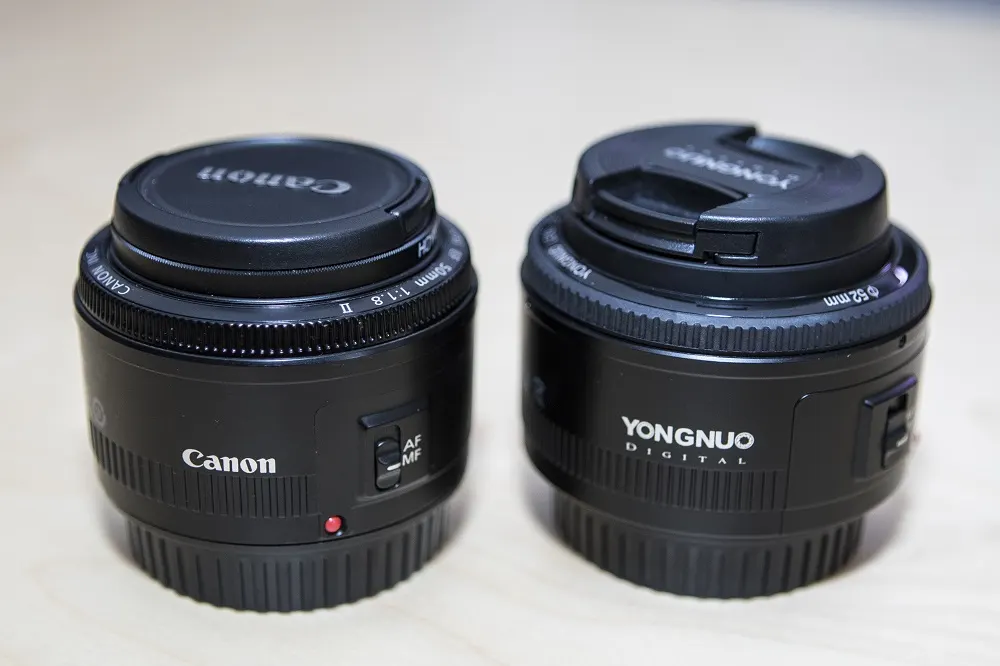
Yongnuo, more known for budget flash guns, recently decided they wanted a slice of this action as well, and have released a 50mm f/1.8 to rival Canon’s massively popular 50mm f/1.8 prime lens, along with a 35mm f/2 and a 50mm f/1.4. The 50mm f/1.8 is so popular, I’d easily say it is something which should be in every camera bag; it really is a wonderfully cheap and versatile lens. Considering the Canon version is so affordable, does the world need an even cheaper option? Variety is never a bad thing, and if it can perform well, why shouldn’t it be a viable option for those on a budget?
For Yongnuo’s first lens, first impressions are good; it feels perfectly acceptable, easily as well made as the Canon. Ok, it feels cheap and plastic, but so does the Canon if I’m totally honest; they don’t call it the plastic fantastic for nothing! The Yongnuo’s focus ring feels decent, and has a rubber coating to it which is a nice touch. Quite frankly, it’s more of a complete copy of the Canon, as opposed to an alternate version. Without looking, I don’t think you would tell the difference between the two.
I’ve heard many people gripe about the noisy focus motor and yes, it makes a noise but guess what… so does the Canon. There’s virtually nothing in it between the two. It’s hardly like the Yongnuo sounds like a motorcycle or something. I’ll tell you what it sounds like. It sounds like a budget lens focussing! Is it a problem? No, not at all. Are you going to get funny looks from people because your lens is noisy? Absolutely not.
I’ve also heard horror stories about the image quality compared to the Canon. I’ve heard people say it’s completely unusable; that it is just not sharp until you hit f/8, and the sharpness falls out as you move away from the centre. There’s perhaps some truth to that, but I’d say nowhere near as bad as people make out. Yes, sharpness does drop a bit by the edges, but you have to consider what you’re using this lens for. Chances are, you’re trying to blow out the background behind a focal subject, so soft corners really aren’t going to be the end of the world.
The biggest noticeable difference between the Canon and the Yongnuo is at f/1.8, where the focus is very soft. As you stop back, it becomes much sharper. Even at f/2.8 it’s pretty much on par with the Canon. By f/4 there’s hardly any difference at all and matches all the way to f/22. The images appear perfectly usable, and as sharp as you would expect from a lens costing under £100. The Yongnuo does produce more chromatic aborations than the Canon version, but Light Room seems to sort out the worst of it.
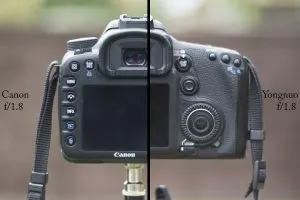
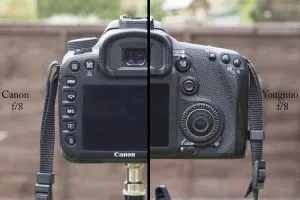
I’ve included a link to a full side by side comparison from f/1.8 to f/22, showing both the Canon and Yongnuo 50mm f/1.8 on a 7D mkII so you can judge for yourself.
Overall, for what it costs, I don’t think it is a bad lens. I’m not sure the grief people give it is really that justified. It feels cheap, but it works. Focus is soft at f/1.8 but it’s not horrendous. Stop down to f/2.8 and it’s perfectly acceptable. Would I personally choose it over a Canon 50mm? No, I’d spend the extra money on the Canon; but for those on a budget I think it’s a decent enough option, especially for those who are unsure how much they’d use it. At around £60, even if you use it once or twice, I think it’s something worth having in your bag. I am interested to seeing what the 35mm f/2 and the 50mm f/1.4 are like.


Leave a Reply