Samyang 20mm f/1.8 – Review
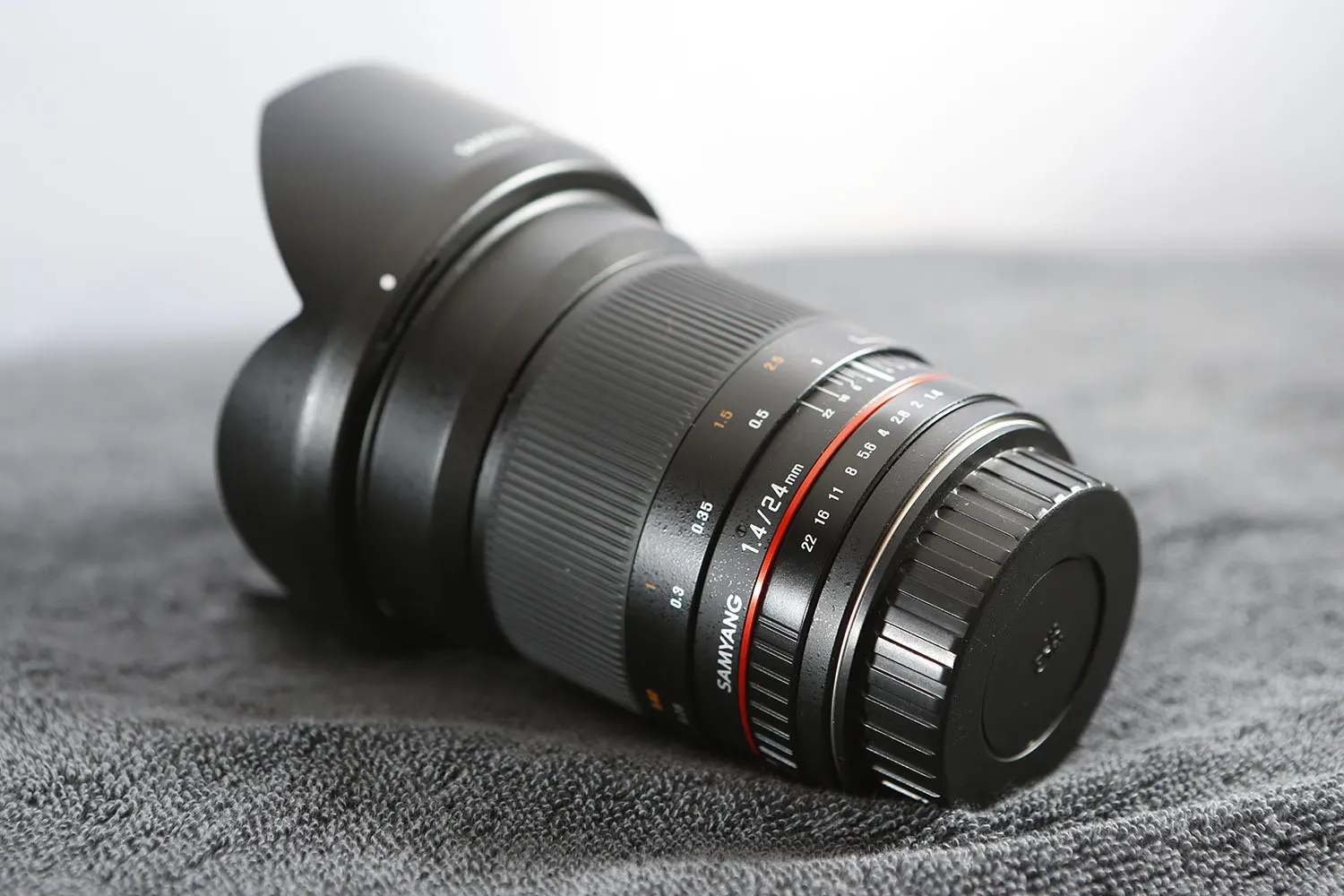
It is always difficult to try to remain impartial and give constructive, and at times, negative feedback to a product, especially when you have shelled out your own money to buy it. There is an element of not wanting to admit you have made a mistake and bought the wrong product. You might have previously read my less than glowing review of the Samyang 24mm f/1.4. To say I tore it to shreds would be unfair, but I like to think I highlighted some fundamental drawbacks in a lens that really relied heavily on its specifications to be the lens of choice. Very wide-angle, fast lenses, especially manual ones, have a limited target market; they are not a “must have in your camera bag” lens unless you spend most of your time shooting landscapes in the dark. Because of this, they have to excel to be considered and the 24mm f/1.4 just did not excel.
Well, it is not surprising that the review made its way back to Samyang and some conversations were had. As a now well regarded company, they were disappointed that their product did not meet expectations and asked if I was interested in trying something else to boost my confidence in the company and their products. Naturally, I am never going to turn down the opportunity to try some gear out, no matter how bad my previous experiences; I do not tend to hold grudges.
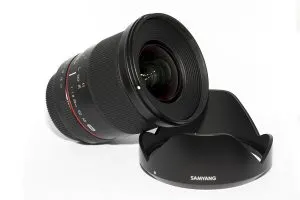
What landed on my doorstep was this; the Samyang 20mm f/1.8 (or T1.9 for those cinematographers out there). Now I will admit I did not even know this lens existed, but it certainly peaked my interest. It sits quite perfectly between the 14mm f/2.8 and the 24mm f/1.4, offering a wider aperture over the 14mm and a wider field of view over the 24mm. That could be the perfect combination for those astro photographers out there, which is who I think this is aimed at. I cannot see many other uses for a fast, 20mm lens. At around £400, it’s quite a bit cheaper than the Sigma 20mm f/1.4 Art lens, which is the closest I can find as a direct competitor, although the Sigma is beautifully made and has autofocus so it’s not really the fairest of comparisons.
First impressions are good; it feels chunky and well made like other Samyang products. Like the 24mm I tested, it is certainly not the smallest lens out there at nearly 90mm long, nor is it the lightest at just shy of 500g; however I would not consider it “big” or “heavy”. It is a nicely proportioned lens, which feels well balanced on the camera. As with other lenses in the Samyang line up, it is the usual plastic construction with a decent, large rubber coated focussing ring. There is no weather sealing, but at this price point, that is not a deal breaker. A detachable lens hood is supplied which clicks in place firmly, and reveals another advantage to this lens over others, the 77mm filter thread; something the Sigma Art lens does not offer.
I am sure some people will complain that this lens is not exactly packed to the roof with features. Yes, it is a manual focus / manual aperture lens and there is no image stabilisation or anything but that is what we have come to expect from Samyang at this price point. As with other models, there are two versions of the lens are available; a photographic version with a clicked aperture ring and a cine version with an unclicked aperture ring. That is about as advanced as it gets. It is designed to work on full frame bodies however, which is a great plus, and optically has potential with 13 elements. Minimum focussing distance is impressive too, at just 0.2m. It does only have 7 aperture blades so your bokeh is not going to be the creamiest, but still decent none the less. As before, the aperture is selected by rotating a dial at the base of the lens, close to the camera body. The clicks are solid and give a good range from f/1.8 to f/22 in half stop increments.
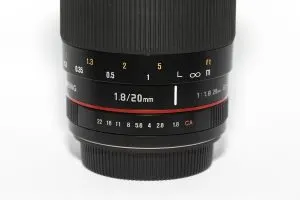
One major issue I had with the 24mm f/1.4 I tested was the immense amount of slack or delay in the focus ring. Trying to achieve perfect focus was like trying to wrestle a lion while on fire. Ok that might be a slight exaggeration but you get the idea, it was difficult. The 20mm f/1.8 however, well what a difference! The focus ring is incredibly responsive with just the right amount of resistance. It was an absolute joy to use and getting perfect focus was much, much easier; which is important as this is a manual lens. One point to the 20mm! If I were to be overly critical, the one thing I would say is that focus is very difficult to achieve using the viewfinder. This is not an issue with the lens, more an issue with the physics. At 20mm it’s very wide and things in the frame, generally, tend to be quite small. Getting pin sharp focus on very small details is quite difficult and I found myself having to use Live View and zooming in on the screen to dial in the focus. For astro, that is not an issue but as a walking around lens, I think it would be a struggle.
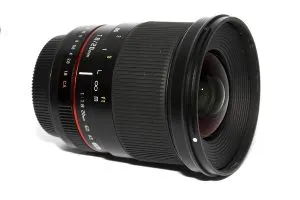
While both lenses scored equally on the build quality, it was really on image quality where the 24mm f/1.4 fell down and where I hoped, the 20mm f/1.8 stepped up. Last weekend saw the peak of the Perseid Meteor Shower, and a clear night gave me the perfect opportunity to test this lens in its preferred environment.
One thing I always like to do with a new lens before heading out into the dark is work out where infinity focus is. Doing this in the daytime makes life a lot easier as some lenses, especially the cheaper ones, can vary on exactly where on the scale infinity focus is achieved. The Samyang 14mm f/2.8 for example achieves infinity focus past the marker, and pretty much right at the focus end stop. On this lens however, infinity focus was achieved absolutely bang on the infinity marker line. In the dark and focussing blind, this is a major advantage and takes a lot of the guesswork out of things.
The focal length is pretty decent, especially on a full frame, and more usable than the 24mm variety. Using it on a crop camera with give an effective 30-32mm so stitching images together might be the preferred choice if you want a wider field of view. Distortion is handled very well; barrelling is kept to a bare minimum, which is great for landscape and architecture where lines are important. Vignetting, like on the 24mm, is a different story. Vignetting at f/1.8 is quite heavy, a good 2 stops or so in the extreme corners. Stopping down to f/2.8 improves things dramatically; although some vignetting is still experienced, it is far less obvious and more easily fixable in post. Past about f/4 it is all but gone. Chromatic aberrations are well controlled even wide open; it is quite minimal and again stopping down slightly gets rid of the issue.
One issue a lot of wide and fast lenses display is Coma; the odd oval-shaped distortion of stars in the corners of the frame. Some big brand lenses suffer from this very badly and rule themselves out of the astrophotographer’s kit bag rather quickly indeed. Samyang have always been renowned for having the best control of Coma and thankfully, this lens is no different. Stars remain perfectly round with no signs of any distortion in the corners, even at wide open. I don’t know what Samyang do that others do not, but they need to take note.
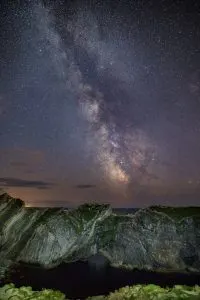
So that just brings us onto sharpness, the Achilles heel of the 24mm f/1.4, and the reason for this review in the first place. For this 20mm lens to replace my trusty 16-35mm f/2.8 and be crowned my favourite astro lens, it is really going to have to pull something out of the bag. I am pleased to say, it does! The detail captured was stunning and better than any other lens I have used to date. Wide open at f/1.8 it is super sharp. None of the soft white glow is present as in the 24mm. Sharpness in the centre of the frame is fantastic, but does drop out slightly at the corners. Stop down a little and sharpness improves further, and at f/2.8 is sharp edge to edge. During the night, I did find myself preferring to stop down a smidge and shoot at f/2.4 rather than f/1.8 but that was due to the vignetting as opposed to the sharpness. Overall though, this lens is very sharp indeed and if you can handle the vignetting, shooting wide open is not an issue and helps keep that ISO lower.
So the question of the night… if it were my own money, would I go out and buy this lens? It is a tough one. If I was an APS-C shooter I think I would still go for the Samyang 14mm f/2.8 primarily for the extra field of view. If I shot full-frame and already had a 14mm f/2.8 in my bag, I do not know if this offers enough advantage to warrant the extra spend. If I wanted something to use as a walking around / street photography lens, the lack of autofocus and difficulty in focussing using the viewfinder would probably make me look elsewhere. Personally though, for what I do, yes I would buy this lens. As a full frame shooter who enjoys a spot of astro / Milky Way photography and wants a wide angle, wide aperture lens which delivers great detailed images, it fits what I want from a lens and it is a cracker. It seems to fix every gripe I had about the 24mm f/1.4, and that impresses me!
“My favourite lens I have used for astrophotography. It is a little niche in my view and is almost a single purpose lens which is not suitable for much else, but if an astro lens is what you need, you definitely can’t go wrong for the price. A massive, massive improvement over the 24mm f/1.4 in my opinion.”
Leave a Reply