Samyang 24mm f/1.4 ED UMC – Review
Astrophotography is becoming big business. The kit available for capturing the milkyway, or distant galaxies and nebulae is growing by the day, as is the amount of people venturing out into the darkest areas of the country at the first sign of a clear night. The first problem anyone who’s tried their hand at astrophotography will tell you is getting enough light to the sensor; stars really are a teeny-tiny light source. You have 3 options. You could have the shutter open for a longer amount of time, but due to the rotation of the earth, the stars move across the sky. The focal length limits how long you can have your shutter open before your star points become star trails. Wider focal lengths allow for longer shutter speeds. You could bump the ISO into 4 or even 5 figures, but the amount of noise you’ll introduce into the image really starts to cause problems. Your final option is to open the aperture up wide, letting in as much light as possible, but that’s limited by your lens.
A lot of kit lenses will have a max aperture of around f/3.5, while more expensive options will stretch to f/2.8. Both are perfectly capable of taking photos of the stars, but at the expense of either the shutter speed or the ISO. Thankfully, there are options out there that stretch the max aperture even further, to an excellent f/1.4. That’s 2 stops more light than an f/2.8 lens… or to put it another way, the ability to use ISO 500 instead of ISO 2000 for example. There are plenty of choices out there. Canon and Nikon both have their own range of wide angle f/1.4 lenses, but they have a hefty price tag of somewhere near £1500. A lot of money to spend! Thankfully, 3rd parties have again come to the rescue with some more affordable options.
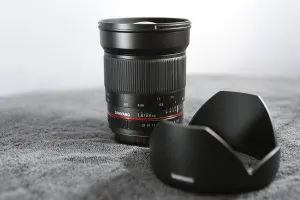
Introducing the Samyang 24mm f/1.4. You may also know it under the pseudonym of Rokinon or Bower; they’re all the same lens made by the same company, just under different names. The Samyang is available in a range of fitments for all of the major players including Canon, Nikon, Sony and Pentax. The first thing to note, unlike the big named versions, the Samyang only costs around £450; that is quite a saving over the others. You do lose some features though. The Samyang is a manual focus, manual aperture lens but that really shouldn’t be an issue for astrophotographers and landscapers.
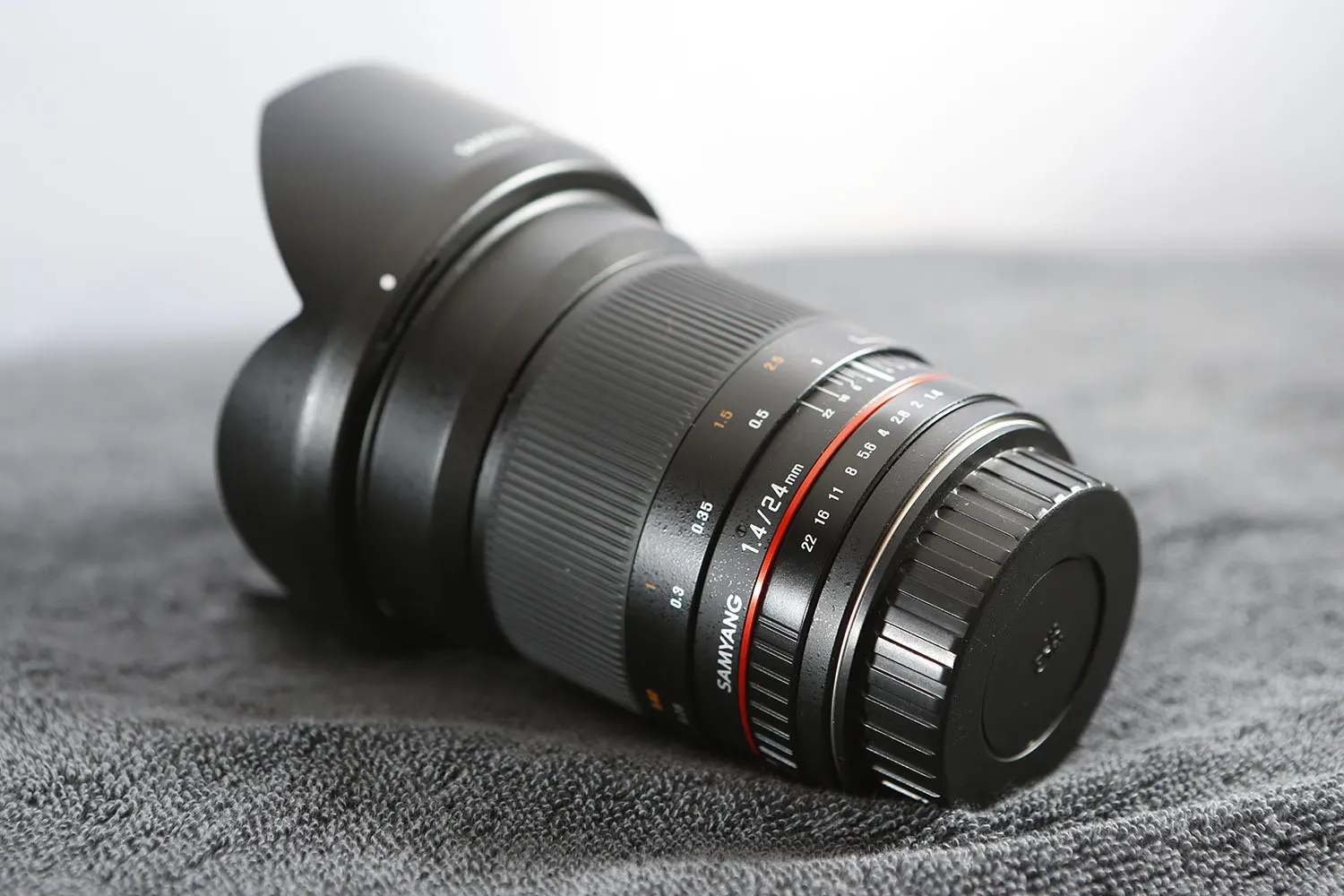
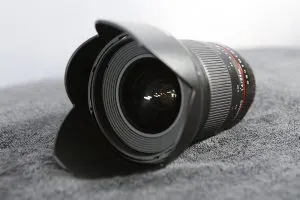
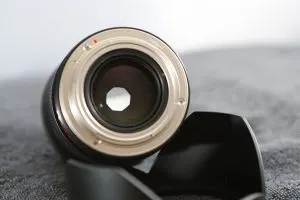
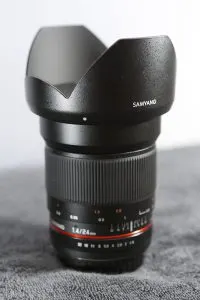
Aesthetically, this is a very nice piece of kit. It’s a plastic construction, but feels of a decent quality. The focus ring is chunky and covered in a rubber layer which aids grip, and rotates nice and smoothly. The aperture ring clicks definitively into place every half stop. The lens is on the larger size, although the f/1.4 aperture will be a factor in that, measuring in at 97mm long (or 140mm long with the lens hood fitted) and sporting a 77mm front thread, which means you’ve probably already got filters that fit. A weight of around just under 700g goes to reinforce the quality made feel. Top marks for build quality.
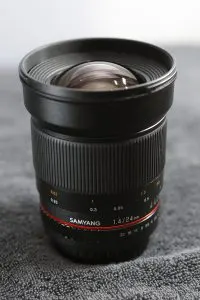
Taking the lens out for a field test yielded some interesting results. The ability to open the aperture up two stops wider resulted in a much cleaner image due to the lower ISO, and captured a wonderful view of the stars. What I did notice however, was that nothing was pin sharp, despite being perfectly aligned with the infinity scale, something crucial in astrophotography as you’re generally focusing blind. Not particularly surprising though, as many lenses are slightly off in this respect. Further tests in the daylight revealed the issue however. Focusing this lens is a nightmare; there is so much slack in the focus ring, getting that focus absolutely nailed is almost completely impossible. The unit we tested had in excess of 3mm slack either way on the focus ring. That’s 3mm of movement with absolutely no change in focus at all. Using Live view and zooming in helps a little but it is still inconsistent at best.
If you finally do manage to achieve focus and open the aperture up to the widest f/1.4, you’ll be treated to a lovely soft glow around any areas of contrast. This lens is incredibly soft wide open, to the point I’d say it’s unusable. It’s not until you stop it down to f/2.8 that you start to get a sharper image, and from about f/4 to f/11 things actually look pretty good. Go further than f/11 and you start to hit sharpness issues again however.
“But all lenses suffer at their widest aperture” I hear you cry from the rafters. We tested the Samyang alongside a Canon 24-70, both set at 24mm f/2.8 and honestly, you’d be hard pushed to decipher between the two images. The more versatile, auto-focus lens is just as sharp wide open as the Samyang is 2 stops from its widest. The ability to take advantage of the Samyang’s super wide aperture is negated by the poor image quality at that super wide aperture.
Now, I know this lens wasn’t specifically designed for wide open “astrophotography” and obviously has other uses in the wide world. Shooting a standard landscape in the day time, set to a sensible aperture and roughly focused, provides far more sensible results; similar in image quality to higher priced lenses I might add. Chromatic aberrations are kept to a minimum, however vignetting is not! At f/1.4, vignetting is terrible; but we’ve already concluded that it’s unusable at f/1.4 anyway so that solves that problem. It does improve as you stop down, but it’s still quite pronounced even at f/8, and Lightroom’s profile correction doesn’t seem to get rid of it that effectively either.
It is such a shame. I was really looking forward to testing this lens and seeing it’s results; unfortunately, that excitement was lost when I saw those results. The advantages this lens claims to have over others is void when better results can be achieved with more versatile f/2.8 lenses. What’s the point in having a lens boasting an amazing f/1.4 aperture if it’s only usable at f/2.8?
It maybe we have a duff lens; Google is flooded with stories of quality control issues by Samyang, but until I can get my hands on another to test, I’m not sure I can recommend this lens to those looking for something wide and fast. I have heard better results from the Samyang 14mm f/2.8 but for those using APS-C bodies, I recommend the Sigma 18-35 f/1.8. You can read my review here.
“I’ll give it 2 stars for its build quality and image quality from about f/4 onwards. If you’re purchasing this as an astrophotography lens like myself, I’d steer clear and look elsewhere. If you do decide this is a lens you’d like to try, watch out for poor quality control. Thankfully, I’ve heard Samyangs customer service is very good”

Leave a Reply